RFID Card Printing for Attendance and Access Control
Custom printed RFID cards with reader compatibility checks, sample testing and bulk employee or student data support.
We supply RFID cards for authorised attendance, door access, school, library and compatible parking applications. Because RFID technologies are not interchangeable, we first identify the frequency, chip or protocol and software requirements of your existing system.
Call Now WhatsApp
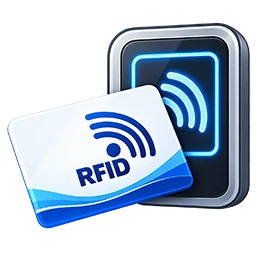
What Is an RFID Card and How Does It Work?
RFID means Radio Frequency Identification. A typical contactless card contains a chip and an antenna inside the plastic body. When the card enters the working field of a compatible reader, the reader communicates with its credential and passes the result to attendance, access-control or other authorised software.
RFID is not Wi-Fi. The card-to-reader connection uses RFID radio communication. A reader, controller or cloud attendance application may separately use Ethernet, Wi-Fi or the internet, depending on the installed system.
RFID Frequencies and Typical Uses
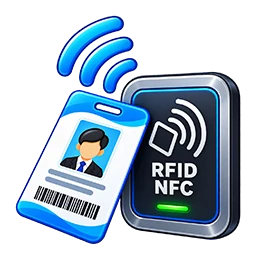
125 kHz LF
Low-frequency credentials generally work at short proximity and are common in legacy attendance and door-access systems. Many store a basic identifier, but exact performance and security depend on the chip and system.
13.56 MHz HF
High-frequency smart cards include several standards and chip families. They may offer more memory and security options than basic LF credentials. NFC also operates at 13.56 MHz, but not every 13.56 MHz card is NFC-compatible.
UHF / RAIN RFID
UHF systems can support longer reading distances and are used for applications such as vehicle identification, parking or asset tracking. Frequency regulations and system design vary by country, reader and installation.
Important: LF, HF and UHF cards cannot be substituted only because their size looks the same. The reader and credential technology must match.
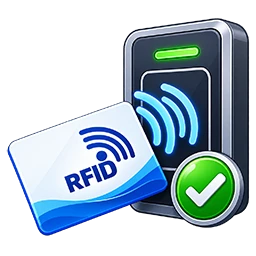
Match the Card with Your Existing Reader
Before bulk printing, share the reader model, current working card, software details and authorised system requirements. A printed card cannot be made compatible by changing only the visible card number.
- Frequency: 125 kHz, 13.56 MHz or the required UHF band
- Chip family, protocol and supported standard
- Credential format, facility code or bit format where applicable
- Reader, controller and attendance-software compatibility
- Sample enrolment and a real read test before bulk production
Where RFID Cards Are Used
Printed RFID Cards and Bulk Data

Card Design and Finish
We can print a company or school logo, employee or student photo, name, code, designation or class, validity and approved contact details. Glossy and matt finishes are available according to the selected card stock and printing method.
Direct thermal or UV printing is possible only when the card surface, embedded chip and printer are compatible. Printing must not damage the internal antenna or chip.
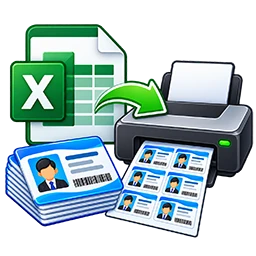
Excel Data and Credential Mapping
For bulk orders, employee or student details can be prepared in Excel or CSV. Each approved person is mapped to the correct card number or credential inside the organisation's authorised system.
The visible employee code and the electronic UID are different fields unless the system administrator intentionally maps them. Sensitive credential data should not be printed openly unless required.

Design Approval, Sample Testing and Production
- Requirement check: confirm application, reader model, frequency, chip and quantity.
- Design proof: prepare the card layout with approved logo, photo and fields.
- Data proof: check names, employee or student codes, photos and validity.
- Sample test: test a sample on the customer's actual authorised reader and software.
- Bulk production: print only after design, data and compatibility approval.

Lost Cards, Security and Authorised Use
If a card is lost, the system administrator should deactivate its credential immediately, review relevant access activity and issue a newly authorised replacement. Retaining the old record as inactive usually preserves a useful audit trail; access logs should be managed according to the organisation's security and privacy policy.
Security depends on the complete system, not only the card. Legacy systems that trust a simple identifier may provide less protection than properly configured secure credentials. Organisations should select suitable card technology, protect enrolment permissions and use qualified access-control support.
We do not copy, clone or create unauthorised access cards. Orders must come from an authorised organisation or responsible system owner. Misuse of credentials may be illegal and unsafe.
RFID Card vs Normal PVC ID Card
| Feature | RFID Card | Normal PVC Card |
|---|---|---|
| Inside the card | Electronic chip and antenna | No RFID credential |
| Main purpose | Compatible attendance, access or identification system | Visual identification and printed information |
| Reader required | Yes, a compatible RFID reader and system | No electronic reader for visual use |
| Printing | Logo, photo and details can be printed on suitable stock | Logo, photo and details can be printed |
Frequently Asked Questions
Can one RFID card work with every reader?
No. Frequency, protocol, chip and credential format must match the installed reader and software.
Is every 13.56 MHz card an NFC card?
No. NFC works at 13.56 MHz, but the HF family includes technologies and modes that are not automatically NFC-compatible.
Can you print employee or student information on an RFID card?
Yes. Approved names, photos, codes, designations, classes and validity details can be printed after compatibility and layout checks.
Do you provide delivery?
We serve Ahmedabad and Gujarat and can dispatch approved orders across India. Courier or delivery charges are additional and depend on destination and shipment.
Related ID Card Solutions
Compare NFC cards, view employee ID cards, learn about access-control cards, or contact us with your reader details for a compatibility discussion.
Need Compatible RFID Cards for Your System?
Share your reader model, working-card details, required quantity and print design. We will review compatibility before recommending a card.
+919825777783 WhatsAppSupport Our Free Tools
If our free tools, templates and resources helped you, you can support us with a small contribution.
Support Us