Healthcare ID Card Printing for Hospitals and Clinics
Clear, professional identification cards for doctors, nurses, hospital employees, patients and authorised visitors.
IDCard99 provides custom card design, photo preparation, proof checking and bulk printing for authorised healthcare organisations. Every layout is planned around readable identification, the correct staff role and responsible handling of personal information.
Call Now WhatsApp

What Is a Healthcare ID Card?
A healthcare ID card is an identification credential issued by a hospital, clinic, diagnostic centre, pharmacy, laboratory or another authorised healthcare organisation. It helps people recognise the cardholder's approved role and may support internal attendance, access or registration workflows.
A card improves visible identification, but it is not a medical licence and should not be treated as the only proof of professional qualification. Hospitals should verify employment, designation and permissions through their own records and policies.
The layout should be easy to read at normal viewing distance. Clear photography, strong contrast, sensible font sizes and distinct role information are more useful than decoration that makes identification difficult.
Different Cards for Different Healthcare Roles

Doctors and Nurses
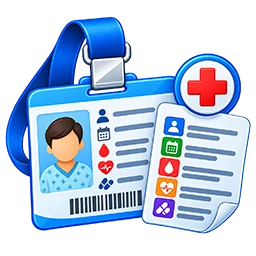
Visible name, photograph, designation, department, employee or registration reference where authorised, and organisation validity.
Hospital Staff
Cards for administration, laboratory, pharmacy, housekeeping, security and support teams should show the correct role without suggesting clinical authority.

Patients
A patient card may show a name, photograph and hospital registration number according to policy. It should avoid unnecessary diagnosis or sensitive details.
Visitors and Vendors
Temporary cards should look different from staff cards and show visitor status, permitted area, issue date or expiry when required.
Recommended Healthcare Card Details
Front Side
- Hospital or clinic name and approved logo
- Clear, recent cardholder photograph
- Full name and employee or patient identifier
- Designation, department or visible card category
- Validity or issue period where required
Back Side
- Organisation address and official contact details
- Return-if-found or lost-card instructions
- Authorised signature or issuing authority
- Approved barcode, QR code or credential reference
- Role-specific instructions that remain readable
Privacy first: do not print a diagnosis, treatment details, passwords, full medical history or other sensitive information merely because space is available. Display only what the healthcare organisation has lawfully approved and genuinely needs.
Patient Identification Requires More Than One Card
A patient ID card can help connect a person with the hospital's authorised registration record, but clinical identification must follow the provider's complete verification process. International patient-safety guidance recommends using at least two person-specific identifiers before care; a room or bed number should not be used as an identifier.
Hospitals may select identifiers such as full name, date of birth, assigned patient number or another approved person-specific identifier. The exact process belongs to the healthcare provider and must account for local law, privacy, newborns, unconscious patients and people with similar names.
A printed card, barcode or RFID credential supports the workflow but does not replace staff verification. Incorrect records can be reproduced quickly by automated systems, making data proofing especially important.
Barcode and QR Code Use
A healthcare card can include a barcode or QR code when it is part of an authorised compatible system. A code may carry a short patient or employee reference, or open a secure authenticated application. It should not expose sensitive health information through an ordinary phone scan.
- Use the minimum data required for the approved workflow.
- Prefer an internal identifier or secure reference instead of plain medical details.
- Check print size, contrast, quiet zone and scanner compatibility on a physical sample.
- Protect the connected database with proper authentication, permissions and audit controls.
- Do not assume that a visible QR code provides security by itself.
Barcode and RFID systems can assist matching and record retrieval, but the healthcare organisation remains responsible for patient verification and data protection.
Hospital Attendance and Access Integration
Suitable RFID or smart cards may support authorised staff attendance and access-control systems. Reader frequency, chip, credential format, controller and software must all be compatible. A printed staff number alone does not confirm electronic operation.
Permissions can be configured for departments, shifts, pharmacies, laboratories, record rooms or other restricted locations when supported by the installed system. Lost credentials should be deactivated promptly, and visitor access limited by area and expiry.
Electronic access requires coordination with the authorised system administrator or installer. We recommend testing an actual sample on the existing reader before bulk printing.
Card Materials, Holders and Lanyards
PVC and Temporary Cards
Printed PVC is suitable for regular staff identification. Paper or synthetic inserts in a clear pouch can serve short-term visitors, contractors or temporary staff when policy permits.
Material, finish and service life should be agreed before production. Smart cards need compatible printing methods that do not damage internal electronics.
Holders and Lanyards
Options include clear pouches, rigid holders, clips, reels and printed cotton or satin lanyards. Role colours can improve recognition, but each organisation should use a consistent policy.
A breakaway lanyard or alternative attachment may be appropriate in some work areas. Selection should follow workplace safety and infection-control requirements.

Cleaning the Card and Holder
Healthcare facilities should include badges, holders and lanyards in an appropriate cleaning policy based on use and contamination risk. Always follow card, holder and cleaning-product manufacturers' instructions, including material compatibility, concentration, contact time and safe handling.
- Remove visible dirt using an approved method before disinfection where required.
- Do not use abrasive material that damages printing, photographs or barcode readability.
- Do not immerse a smart, magnetic or contactless card unless its manufacturer allows it.
- Replace cracked holders, damaged cards or worn lanyards that cannot be cleaned properly.
- Follow the facility's infection-prevention team rather than a generic online recipe.
Bulk Excel Data and Proof-Checking Process
- Organisation approval: confirm card categories, branding, required fields and privacy rules.
- Master design: prepare doctor, nurse, staff, patient or visitor layouts without confusing roles.
- Data preparation: arrange approved names, codes, departments, photographs and validity in Excel or CSV.
- Photo processing: crop photographs without stretching and maintain a consistent visible face position.
- Proof PDF: check organisation details first, then every name, photo, code, role and validity.
- System sample: test barcode, QR code or electronic credentials when included.
- Final approval: print only after the authorised representative accepts the design and data proof.
This process reduces repeated errors across a large batch, but the healthcare organisation remains responsible for confirming roles, patient records and system permissions.
Lost Cards, Privacy and Authorised Use
A lost staff, patient or visitor card should be reported to the issuing organisation. Electronic credentials should be disabled in the authorised system, relevant events reviewed and a replacement issued according to policy. Keeping the old credential inactive can preserve an audit trail.
Personal and healthcare information must be collected, shared, stored and deleted only through authorised processes. Publicly visible card content should be limited, while connected databases should use appropriate access controls and accountability.
We do not produce fake doctor, nurse, hospital, pharmacy, laboratory or government healthcare IDs. Orders require organisation approval. We do not support false qualifications, unauthorised entry or misuse of patient information.
Frequently Asked Questions
Can one design be used for every hospital role?
A consistent brand can be used, but doctors, nurses, non-clinical staff, visitors and patients should remain clearly distinguishable.
Should blood group be printed on a healthcare staff card?
Only when the organisation has a lawful, verified and necessary policy for displaying it. Printed information should not replace clinical testing or emergency protocols.
Can you print smart hospital access cards?
Yes, subject to authorised reader and chip compatibility. A physical sample must be tested before bulk production.
Do you deliver outside Ahmedabad?
Yes. We serve Ahmedabad and Gujarat and can dispatch approved orders across India. Courier or delivery charges are additional.
Related Identification Services
Explore employee ID cards, access-control cards, visitor ID cards and RFID cards, or contact us with your healthcare organisation's approved requirements.
Need Healthcare ID Cards for an Authorised Organisation?
Share the card categories, approved fields, quantity and required accessories. We will prepare a design and data-proof process before printing.
+919825777783WhatsAppSupport Our Free Tools
If our free tools, templates and resources helped you, you can support us with a small contribution.
Support Us