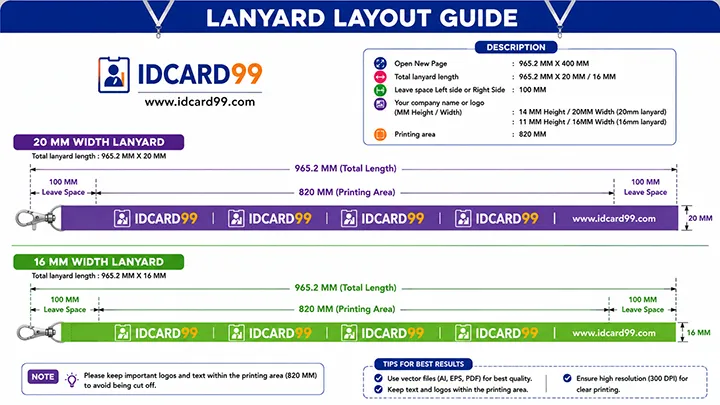
Lanyard Layout & Standard Size Specifications

This lanyard layout is designed following standard card dimensions, ensuring proper alignment of personal details, photo placement, and essential information for clear and professional identification.

Published • Jan 01, 2026
Standard Lanyard Layout Design for Branding and ID Cards

Lanyard Design Structure, Types and Significance In Branding & Identification

Most people think of a lanyard simply as a convenient way to wear their ID or keys, but in fact they serve much larger purposes when it comes to identification, branding, security and professionalism. Lanyards are worn by staff, students, visitors and participants in offices, schools, colleges, hospitals, factories as well as at large events such as shows and exhibitions on a daily basis.

Material and attachments aside, the real power of a lanyard isn’t in what it’s made with or how it’s attached—it’s all about the lanyard layout—how text, logos, colours and design elements are organized along your strap.

Good lanyard design enhances visibility, comfort, readability and brand memorability—and bad lanyard design can make even the best-made lanyard look unprofessional. In this post, you’ll learn everything you’ve ever wanted to know (and then-some) about a lanyard layout – what exactly it is, why it’s important, the components of good design work, types of lanyards, how printing works for this application, best practices and mistakes to avoid… so that your final product is both functional and hard-hitting.

What Is a Lanyard?

A lanyard is a rope, cord, or strap used to secure a small object such as a whistle, knife, work badge, camera, cell phone, identification card, key chain and so on. It typically features some sort of attachment at the end, like a hook or clip or buckle.

Common Items Carried on Lanyards

  • ID cards
  • Access cards or RFID cards
  • Keys
  • USB drives
  • Event badges
  • Security passes

Where Lanyards Are Commonly Used

  • Corporate offices
  • Colleges and Schools
  • Seminars and Conferences
  • Exhibitions and Trade shows
  • Laboratories and Hospitals
  • Factories and industrial units
  • Government institutions

In all these settings, lanyards have three primary functions:

  • Identification
  • Security
  • Brand representation

What Is a Lanyard Layout?

Both Sides (Lanyard Layout): Double-sided lanyards have a design printed or woven on both sides of the lanyard. This includes:

  • Logo placement
  • Text alignment
  • colour patterns
  • Spacing and repetition
  • Orientation of content
  • Compatibility with width and attachments

Lanyard designs also need to be legible from all sides (even when the strap is twisted or bent at an angle).

A good lanyard design will guarantee that:

  • The logo is always visible
  • Text remains readable
  • The design is mirrored on the other side
  • Branding remains consistent throughout

Why Lanyard Layout Is Important

1. Brand Visibility

It’s not unusual to be wearing a lanyard and have it on display all day. Below are the things that an effective ideal layout guarantees:

  • Logo of company or institution is evident
  • Repeat brand name at strap
  • colours align with brand identity

Indeed, the lanyards are walking marketing tools for any events and shows, as is brand exposure without extra money.

2. Professional Appearance

Consistent lanyard designs in an institution will give a disciplined and professional look. When your employees wear professional looking, clean lanyards it makes them look more organized and trustworthy (especially in customer service facing positions.)

A standard lanyard design in companies, medical and department of government workers helps build a professional look.

3. Easy Identification

Various lanyard styles allow easy identification among:

  • Employees
  • Students
  • Visitors
  • Vendors
  • VIP guests

This is especially important in:

  • Large campuses
  • Events with thousands of attendees
  • Secure or restricted environments

These colour-coded and labeled illustrations can go a long way in expanding the security of your office or store.

4. Marketing & Promotional Value

Custom lanyards are so frequently retained and reused for years following the conclusion of an event. Your lanyard design will never leave your customers or clients as the overall layout helps expose them to your brand year round.

Components of a Good Lanyard Design

1.Logo Placement

Where the logo will go- The logo is the most important aspect of your lanyard design.

Best practices include:

  • Continuous logo print on the entire length
  • Keeping logos upright when worn
  • Avoiding rotation or upside-down placement
  • Using high-resolution or vector artwork

Logos should not be cut off or sit too close to the edges.

2.Text Content

Some text that are used in lanyard designs:

  • Company or institution name
  • Event name
  • Department name
  • Slogan or tagline
  • Website URL

Text guidelines:

  • Keep text short and meaningful
  • Use readable fonts
  • Maintain adequate spacing
  • Do not use overly thin or decorative fonts

All text should stay readable even if viewed from afar.

3. colour Scheme

The choice of colour has a direct impact on retention and brand recall.

Good colour practices:

  • Match official brand colours
  • Use a very high contrast (light text on dark or dark on light).
  • Limit number of colours not to be too messy
  • Make sure it looks great printed, not just on a screen

Brand recognition is enhanced by the repeated use of colours.

4. Orientation of Design

There are two primary layout possibilities:

One-Side Print Layout

  • Print is on one side only
  • More economical
  • Suitable for simple branding

Two-Side Print Layout

  • Design printed on both sides
  • Maximum visibility
  • Great for events and professional branding

Two-sided printing guarantees branding is seen even when the lanyard turns.

Width of the Lanyard

The size of the lanyard dictates how many information can be placed legibly.

Common lanyard widths:

  • 10 mm - Fine text or symbols
  • 15 mm – Standard branding
  • 20 mm – Clear logos and text
  • 25 mm – High quality and precise designs

Broader lanyards provide a more comfortable and readable.

Types of Lanyard Layouts

1. Corporate Lanyard Layout

Made for the office and professional work environment.

Features:

  • Minimal design
  • Company logo and name
  • Brand colours
  • Clean and formal look

Used for employees, executives and corporate visitors.

2. Event Lanyard Layout

Suitable for conferences, lectures and exhibitions.

Features:

  • Event name and year
  • Sponsor logos
  • Bright and eye-catching colours
  • Two-side printing

Event lanyards frequently become collectibles, thus beaming brand presence in front of the wearer.

School & College Lanyard Layout

Utilized by students, faculty and staff.

Features:

  • Institution logo and name
  • Motto or tagline
  • Tagging (colour by class / department / year)
  • Durable printing for long-term use

These structures also serve to keep order and security on campus.

Visitor Lanyard Layout

Used for short-term identification.

Features:

  • Bold “VISITOR” text
  • High-contrast colours (red, yellow, orange)
  • Simple and readable fonts
  • Minimal branding

Designed for instant recognition.

Printing techniques and their effect on format

1. Screen Printing

  • Best for simple layouts
  • Limited colour options
  • Cost-effective for bulk production
  • Perfect for text or the basic logo
  • Not good for gradients or any complicated designs.

2. Sublimation Printing

  • High-quality and full-colour printing
  • Great for gradients, images and details illustrations
  • Long-lasting and fade-resistant
  • Ideal for branding-heavy layouts

Most commonly used with today's lanyards.

3. Woven Lanyards

  • Knitted text and logos
  • Extremely durable
  • Premium and textured appearance
  • Limited colour detail

Best for long-term use and corporate branding.

Designing Your Lanyard Layout – The Basics

  • Play it simple and cyclic Simplify the design.
  • Make sure text and logos are right side up
  • Sharp printing with vector files
  • Maintain proper spacing between elements
  • Testing it on real lanyard width measure.
  • Don’t overload it with text

A nice design is easy to read even when the lanyard twists and/or folds.

Common Mistakes to Avoid

  • Text too small to read
  • Incorrect or inverted logo orientation
  • Poor contrast between background and text
  • Overloading with unnecessary information
  • Ignoring attachment areas

These errors obscure readability, professionalism and brand value.

Role of Attachments in Design Layouts

Accessories (Add-On Tools) impact available layout area.

Common attachments include:

  • Metal hook
  • Plastic hook
  • Safety breakaway
  • Buckle connector

Text or logo fonts having a size related to the attachment point should always leave some white space not too close to this, as they will disappear (or peel off) in time.

The role of Uniformity in Lanyard design

Standardizing Layouts Throughout an Organization:

  • Improves brand recognition
  • Creates a uniform appearance
  • Simplifies bulk reordering
  • Enhances professionalism

A common event may have a number of predefined layout templates on hand for employees, visitors and events.

Lanyard Layout FAQs

Answers to common questions about lanyard layout — how they work, sizes and more.

The most commonly used widths are 15 mm and 20 mm, offering a good balance of comfort, readability, and space for logos. Wider lanyards (25 mm) suit premium branding, while narrower ones (10 mm) work well for minimal designs.

Two-sided printing is recommended for professional and event use as it maintains brand visibility even when the lanyard twists. One-sided printing is more economical and suitable for simple identification needs.

Sublimation printing is the most popular choice due to its full-colour, high-resolution, and long-lasting results. Screen printing suits simple layouts, while woven lanyards are ideal for premium and long-term use.

Text should be minimal and meaningful, usually limited to a company name, logo, or short tagline. Too much text reduces readability and makes the design look cluttered.

A well-designed lanyard layout improves brand visibility, ensures easy identification, enhances professionalism, and provides long-term marketing value—turning lanyards into walking brand ambassadors.

Need Custom Lanyard & Id Cards?

Get high-quality PVC, RFID, digital membership, etc. cards tailored to your business.

Request a Free Quote