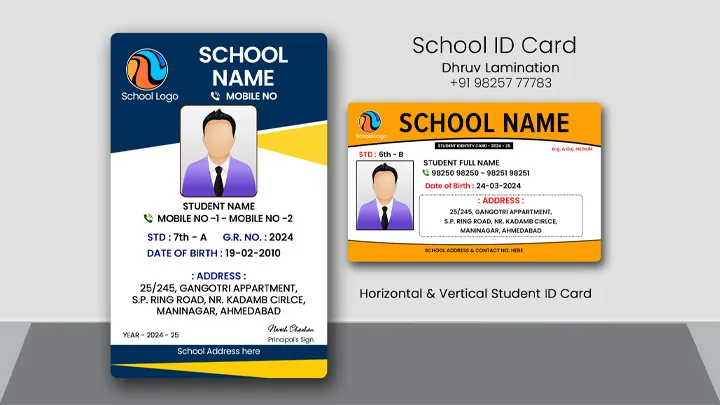

Why Student ID Cards Are Useful
A student ID card helps teachers, school staff and transport teams identify the student, class and school. During a school trip, event or busy dismissal period, the photo and school details make it easier for authorized staff to recognize their own students.
If a young student becomes separated from the school or family, the school contact information on the card may help a responsible adult or police contact the institution. Schools should decide carefully whether a parent number or home address needs to be visible, because the card can be lost or seen by others.
The card can help students remember their GR number, class, division and transport information. A current school-issued card can also help identify a student during examinations and may support an application for a student bus concession pass. Acceptance depends on the relevant school, examination body or transport authority, and additional documents may be required. Student ID cards can also support identification for libraries, school transport and institution-approved activities. However, a student ID card does not automatically replace a passport, government-issued identity document or official KYC document.

Student ID Card Details and Front-Back Layout
The school name, logo, address and contact number identify the issuing institution. Common student fields include the name, photo, class or standard, division, GR number and validity. Depending on school policy, the card may also include a birth date, blood group, parent contact, address, bus number, pickup point or route.
Many student cards are single-sided. A double-sided design provides more room: the front can show the school branding and essential student identification, while the back can carry the school address, email, website, instructions, transport details and selected emergency information.
Print only data that has a clear purpose. A full birth date, residential address and parent phone number are personal information and should not be displayed simply because space is available.
GR Number, Student ID, Class, Division and Bus Number
The GR number is a school admission or general-register reference used to connect the printed card with the school’s own record. A student’s GR number may differ when moving between school sections or institutions according to the applicable record system. Printing a GR number supports identification, but does not by itself turn the card into a government-issued identity document.
A student identifier issued under a state or national education system may follow rules separate from the school’s own records. It should not be confused with the school’s UDISE+ code, which identifies the institution rather than an individual student. Whether a student identifier remains unchanged after a school transfer depends on the system that issued it. Schools should copy all identifiers from authorized records instead of guessing or creating numbers.
Class and division help teachers locate the correct group. A bus number, route or pickup point helps students and transport staff identify the assigned vehicle, especially when several buses use the same colour and branding. The validity year prevents an old card from being treated as current after promotion, transfer or completion of study.

Student Photo Cropping and Image Quality
Use a recent, clear front-facing photograph with the face visible and a simple background. Crop the image to the required head-and-shoulders composition while preserving its original proportions. Do not stretch the photograph or apply edits that change the student’s appearance.
Basic adjustments can improve framing, brightness and background consistency, but the final image should remain a truthful representation of the student. Check photo-to-name matching carefully before creating the class proof.
Schools can also use the online image crop tool for basic preparation before adding the photo to a card layout.
Gujarati, Hindi and English School Templates
Templates can be prepared in Gujarati, Hindi or English according to the approved school format. Unicode fonts help preserve text correctly across compatible systems. Suitable choices may include Rasa or Noto Sans Gujarati for Gujarati, and Noto Sans Devanagari or Mangal for Hindi. English designs may use readable families such as Poppins, Roboto or Montserrat.
Install the required fonts before opening or editing the master design. Proof every local-language name and address with the school because automatic transliteration and typing errors can change the meaning of student information.

PVC, Paper, Pouch and Resin-Finish Cards
PVC cards provide a durable option for regular school use and can be fitted into a holder. Paper cards are useful when an urgent or short-term card is needed; the print can be laminated or placed in a ready-made clear pouch with a clip lanyard.
Some schools choose a resin-finish card, where a printed insert is fitted into a compatible holder and covered with a suitable resin coating. The final appearance and durability depend on the holder, resin system and production method. Materials should be handled according to the manufacturer’s safety instructions, and the finish should be selected based on the school’s requirements and budget.

Student Lanyards
Cotton lanyards provide an economical option for simple school-name screen printing. Satin lanyards offer a smoother finish and can support screen printing or multicolour digital printing. The school name, logo and approved design can be printed before the lanyard and holder are fitted to the card.
Free Student Generator and Custom School Generator
The free student ID card generator uses a fixed public template and is useful for testing or preparing a small number of cards. The available fields, logo and layout have limited customization.
A custom school generator can use the approved school name, logo, colours, background design and fixed instructions. Fields can be added, removed or repositioned according to the school’s data requirements. Access should be shared only with authorized school staff, parents or students under the school’s data-collection policy.
Benefits of Online Student Data Collection
An online form can distribute data entry across class teachers, parents or authorized students and reduce repeated manual typing by one office operator. It can also capture photos and class-specific fields in a consistent format. The school should provide clear instructions, validate submissions, restrict access, obtain appropriate consent and avoid collecting information that is not needed for the card.

Excel, CSV and Bulk Student ID Cards
Organize the student name, GR number, class, division, dates, contact details and transport fields in consistent Excel columns. Save a clean working copy before exporting the required sheet to CSV. Use predictable photo names, such as the GR number or another unique school reference, so each image can be matched to the correct row.
In Photoshop, set up text-replacement and image-replacement variables in the master card design, then map them to the matching column headings in the CSV file. Keep variable names and column headings consistent to reduce mapping errors. Each image variable must reference the correct photo file using the path and format supported by the Photoshop data-set workflow. Import a few sample rows first, then check the names, photos, text alignment and final card layout before generating the full school batch.
CSV imports and image-variable behaviour can vary by software version and file setup. Preserve the original Excel workbook, test special characters and Gujarati/Hindi text, and never begin the full export until names and photos match correctly.

Design Approval and Class-Wise Proof Checking
- Prepare the school design with the approved logo, colours, fields and language.
- Ask the authorized school representative to approve the blank layout and sample card.
- Import the verified student data and correctly matched photographs.
- Arrange approximately ten cards on an A4 proof page where suitable.
- Create class-wise PDF proofs for teachers or authorized staff.
- Correct names, photos, GR numbers, classes, dates and contact details.
- Start final printing only after documented approval.
Proof checking significantly reduces errors, but no workflow can guarantee that every source-data mistake will be found. Final responsibility for student-data approval should remain with the school or authorized representative.
Student Data Privacy and Authorized Use
Children’s information requires careful handling. Collect only the fields needed for the card, protect spreadsheets and photographs, limit access to authorized people and follow the school’s consent, retention and deletion policy. Avoid publicly exposing full addresses, birth dates or parent phone numbers unless the school has determined that the safety benefit outweighs the privacy risk.
IDCard99 does not knowingly create fake, deceptive or unauthorized school, college or student identification. Orders and custom generators must be approved by the institution or an authorized representative.
Student ID Card Delivery in Ahmedabad and Across India
Student cards, selected holders and printed lanyards can be supplied locally in Ahmedabad and shipped to serviceable locations in Gujarat and across India. Courier or delivery charges are additional and depend on the destination, parcel and selected service.
Frequently Asked Questions
Which details belong on a student ID card?
The school name, student name, photo, class, division, GR number and validity are common. Other personal or transport details should be included only when required by school policy.
Is a student card valid for bank or government work?
It may support school identification, but acceptance depends on the organization and applicable rules. It does not automatically replace a government-issued identity or required KYC document.
Can it be used for examinations or a bus concession pass?
Yes, a current school-issued card can help confirm student identity during examinations and may support a student bus concession application. The examination body or transport authority may ask for additional documents.
Can cards be created from Excel and student photos?
Yes. Consistent Excel or CSV columns and correctly named photos can support bulk production after a sample import and class-wise proof are checked.
Do you offer a custom school generator?
Yes. A custom generator can use the school’s approved branding, fields and template, while the free generator uses a fixed public design.
Do you make unauthorized student cards?
No. We do not knowingly create fake, misleading or unauthorized student identification.
Related Student ID Card Resources
Need Student ID Cards for Your School?
Contact IDCard99 for an approved school design, bulk student card printing, accessories or a custom generator.
Contact Us WhatsAppSupport Our Free Tools
If our free tools, templates and resources helped you, you can support us with a small contribution.
Support Us