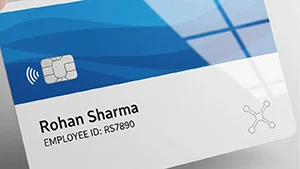
An RFID Card
What does the RFID card do?
An RFID card is a plastic card(usually the same size as your credit card or debit card), with a small antenna and microchip embedded inside. Unlike the use of magnetic stripe card that requires the swiping, the RFID cards may be read by a scanner wirelessly. You just move the card in the vicinity of the reader and it sends information without touching it.
The cards may contain unusual identification numbers, access codes, or payment data, depending on application. The technology that stands behind them is not recent, and it has been in existence since decades but over the past few years, it has become more accessible and utilized.
How Does an RFID Card Work?
RFID is a strategy that applies radio waves in communication between the card and a reader. This is the nutshell version:
- The Card - An RFID chip and small antenna is inside the card.
- The Reader - A device transmits a radio signal.
- The Exchange - As the card comes near (normally a couple of centimeters), the antenna embedded in the card gets the signal.
- Data Transfer - The card transfers its stored data back to the reader.
- Action - The data is transformed to wealth; opening a door, counting someone in or out, authorizing a payment.
All this takes place less than a second. Therefore, RFID seems to move so quickly in contrast with swiping or card input.
Kinds of RFID Cards
RFID cards are not a uniform kind. There are three major categories by which they can be defined depending on how frequently such terms are employed:
- Low Frequency (LF) – The LF operates at 125 kHz and has a short reading range (up to 10 cm). Frequently applied to the access control systems.
- High Frequency (HF) – It works at 13.56 MHz, has a reading range up to 1 meter. This group consists of such cards as NFC (Near Field Communication) that are applied in contactless payments.
- Ultra-High Frequency (UHF) – Operates between 860-960 MHz, and has a greater reading range (can read as much as 12 meters). Not so strongly represented in personal ID cards as in logistics and inventory tracking.
Uses of the RFID Cards
- Commonly Access Control – Common places where these RFID cards are used in the opening and closing of certain places include offices, gyms, and residential buildings.
- RFID in Public Transport - A lot of public transportation systems are using RFID cards to pass their fares easily especially in metro and in buses.
- Hotel Room Keys – RFID cards are used in the hotel to open the rooms instead of keys.
- Event Management – Everybody has definitely encountered this type of RFID in action when they attend concerts, exhibitions, and fairs through the use of RFID cards (or wristbands) to restrict access.
- Payments – Avoidance of tap-and-pay cards with RFID or NFC technology allows fast payment via credit/debit cards.
- Time and Attendance - Companies keep count of working hours of per employee by using an RFID-based attendance systems.
RFID Card Benefits
- Speed - no swiping required and inserting all you need to do is tap and go.
- Damage resistance & longevity – Because there is no physical contact, wear and tear are minimal.
- Security - Cards can be locked and once lost, they can be deactivated.
- Convenience - They are able to keep various kinds of data to use in different variety.
Limitations to be taken into consideration
- Cost - RFID cards cost more than the magnetic stripe card.
- Interference - Things like metal objects, or strong signals can impact on performance.
- Security Threats - Cloneable RFID cards, in the absence of encryptions, can be easily cloned by criminals who are tech-savvy.
What is the Future of the RFID Cards?
The RFID technology demand will presumably continue to rise, particularly in such fields as smart cities, contactless payments, and safe workplaces. Many pundits also feel that RFID will ultimately be combined with biometrics systems--in other words the combination of your card and your fingerprint or face scan will achieve ever greater levels of security.
Final Word
RFID cards may seem to be simple motor outside but they are loaded with technology. They have simplified and accelerated normal things to do that are maybe getting a train ticket, opening a door in the office or buying a cup of coffee. With the world switching to increasingly contactless and secure systems, RFID cards will probably have an even greater role in our everyday life.
RFID Card FAQs
Answers to common questions about RFID cards — how they work, security, policies and more.
Need Custom RFID Cards?
Get high-quality PVC, RFID, digital membership, etc. cards tailored to your business.
Request a Free Quote